
Social Media

  • BlueSky
  • Facebook
  • Linkedin
  • Instagram
  • English
  • Français

Login/Register

  • Login
  • Register
Home
  • Licensing
    • CRKN Licensing Principles
    • Model License
    • The Banding System
    • Stakeholder Alignment Group
    • License Negotiations
    • Negotiation Outcomes
    • Directories
    • Publishers and Vendors
    • Tools and Services
      • Foreign Exchange Service
      • Publication Data Report
      • Unsub
      • Perpetual Access Rights Reports (Serials)
  • Open Access
    • Partnership for Open Access
    • Community Open Access Initiatives
    • Read and Publish Agreements
    • APC Discounts
    • Towards Open Scholarship: A Canadian Action Plan
    • Assessment Guidelines for Open Access Publishers
    • CRKN Open Access Journals List
  • Canadiana
    • About the Canadiana Collections
      • Call for Canadiana Collection Development Projects
      • What’s New in the Collections
      • Navigating the Collections
      • System Status
      • Canadiana Citation Guide
      • Canadiana Infrastructure Updates
      • Canadiana Metadata and Usage Reports
      • Rights Statement Project
      • History of Canadiana
    • Digitization Services
      • Digitization Projects
    • Preservation and Access
      • Trustworthy Digital Repository
    • Digital Heritage Content and Preservation Listserv
    • Acquisition and Use of Commercial Microfilm
    • Future of Canadiana
  • Persistent Identifiers
    • ORCID-CA Consortium
      • How to Join ORCID-CA
      • ORCID-CA Governing Committee
    • DataCite Canada Consortium
      • How to Join DataCite Canada
      • DataCite Canada Governing Committee
    • National PID Strategy
    • Canadian Persistent Identifier Advisory Committee
  • Partnerships
    • NISO Membership
    • SCOAPÂł
    • FMD Membership
    • Coalition for Canadian Digital Heritage
    • HSS Digital Research Infrastructure in Canada
    • More Projects and Collaborations
  • News & Events
    • News
    • 2026 CRKN Virtual Conference
    • 2025 CRKN Member Summit and AGM
    • Code of Conduct
    • Webinars
  • About
    • Board of Directors
    • Members
      • Associate Membership
    • Committees
      • Executive Committee
      • Finance and Audit Committee
      • Content Strategy Committee
      • Preservation and Access Committee
        • Canadiana Content Sub-Committee
        • Platform Technical Sub-Committee
      • Conference Planning Committee
      • Task Groups
      • CRKN Researcher Council
    • Annual Report
    • Staff
    • Careers
    • History of CRKN
    • Ron MacDonald Service Award
    • Strategic Plan
Menu

2025 Wrapped! Licensing Edition đź“–

December 17, 2025
crkn blog

By: Emily Haugen, Strategic Engagement and Communications Advisor

https://doi.org/10.82389/cnhy-jw52 

What’s the CRKN Licensing Program been up to this year?  

It’s been a big year for the Licensing Program. In 2024–25, we made meaningful progress toward our collective goals and continued to deliver strong value to members by pushing for cost containment, expanding equitable access, and strengthening the foundation for open knowledge in Canada.

The CRKN Licensing program was working on big things this past year...


Let’s start with the big numbers 

Every year, member institutions make major investments in scholarly content and support thousands of researchers as they publish in academic journals. Our role is to help reduce those costs so libraries and researchers can continue investing in research, teaching, and knowledge creation. 

This year, CRKN members collectively saved more than $42 million through our license agreements compared to paying full list prices. That’s not just a big number—it’s real, tangible impact across campuses and communities. It means more resources for students, more flexibility for libraries, and more support for the research that drives Canada forward. 

CRKN members saved $42,911,175 through CRKN’s collective negotiating compared to content list prices


Authors are publishing their research without paywalls!  

Open access is something the academic community cares deeply about. When research is openly available, more people can read it, build on it, teach with it, and use it to advance knowledge in their fields. It strengthens scholarship and creates a broader, more equitable foundation for discovery.

But publishing open access isn’t always straightforward—and it’s rarely free. That’s where CRKN’s open access agreements make a real difference. Through our read-and-publish agreements, researchers at CRKN member institutions can publish their work openly at no cost to them.

These agreements remove financial and administrative barriers so researchers can focus on what matters most: sharing their ideas with the world. 

CRKN member-affiliated authors published 15,438 articles open access through our read and publish agreements


We celebrated 11 years of the Partnership for Open Access with Érudit  

In 2025, we celebrated 11 years of collaboration between CRKN and Érudit through the Partnership for Open Access (POA). Since 2014, the POA has supported Canadian scholarly journals and expanded open access without relying on APCs, contributing to the global growth of diamond open access. This community-driven, non-commercial model is now well-established and recognized internationally, with support from more than 90 university libraries and over 240 journals.

In 2024–2025 alone, the POA enabled the publication of 3,801 diamond open access articles and provided direct support to 188 Canadian journals. 
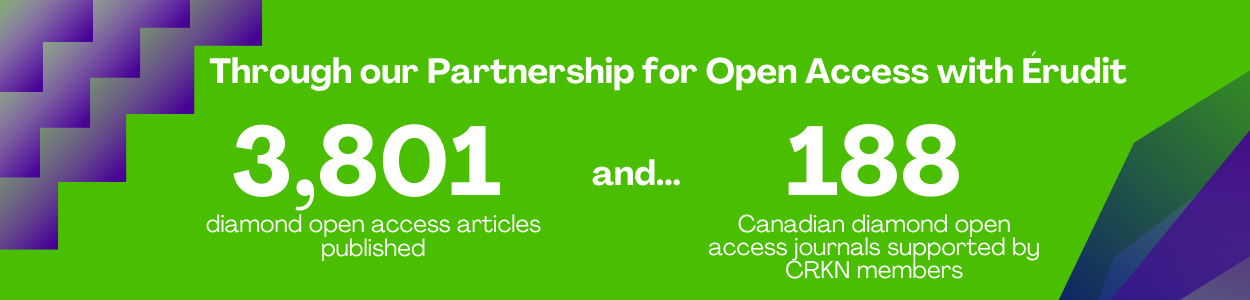
Through our Partnership for Open Access with Érudit  3,801 diamond open access articles published


Speaking of open access… 

In 2025, CRKN members saved more than $50 million in avoided article processing charges (APCs) across CRKN’s Read and Publish agreements with Sage, Wiley, and Elsevier. APCs are fees that authors—or their institutions or funders—must pay to make an article openly available in many journals. These charges are significant, with average APCs at these three publishers ranging from $3,508 to $4,097 per article.

Thanks to the collective strength of CRKN’s national negotiations, researchers can support open access publishing while avoiding these substantial costs. 

 

Speaking of open access... CRKN members saved $50.2M USD in total APC cost avoidance in 2025, across Sage, Wiley & Elsevier alone through our Read & Publish Agreements


The bottom line matters 

Licensing and Open Access are central to how CRKN delivers value to our members. By negotiating as a collective, we reduce costs for academic institutions, strengthen open knowledge in Canada, and expand the reach of Canadian research both nationally and globally. Each year, CRKN negotiates more than $150 million in content across over 50 national licensing agreements and open access initiatives. Through this coordinated approach, member institutions gain affordable access to essential scholarly resources—and researchers benefit from more opportunities to make their work openly available to everyone. 

Currently, CRKN negotiates and manages over 50 agreements on behalf of our member institutions.


Why we work as a collective 

As we look ahead, collective licensing remains one of the strongest examples of how our network creates shared value. By negotiating together, we reduce costs, expand equitable access, and support a more open and sustainable research ecosystem. In an era shaped by artificial intelligence, rising misinformation, and increasing pressure on library budgets, collective action ensures that trusted knowledge remains accessible to the communities who need it most. Our strength has always been collaboration, and through our licensing program, we will continue to champion pathways that empower researchers, libraries, and learners across Canada. 
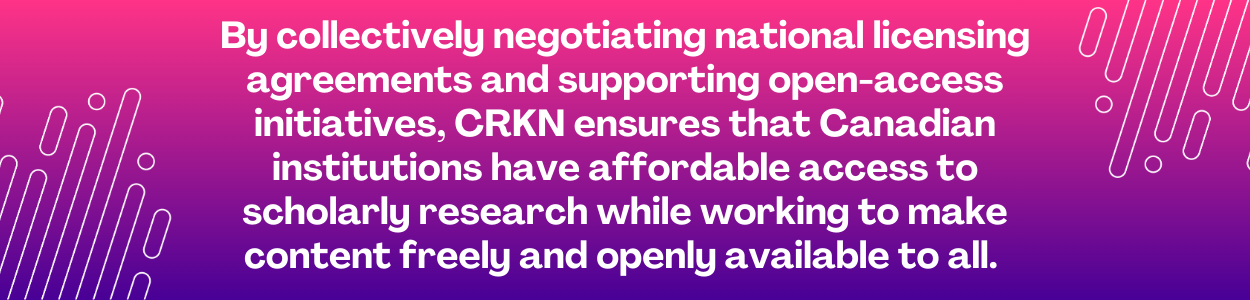
By collectively negotiating national licensing agreements and supporting open-access initiatives, CRKN ensures that Canadian institutions have affordable access to scholarly research while working to make content freely and openly available to all.

Stronger Together

Since 1999, universities and academic institutions across Canada have come together through the Canadian Research Knowledge Network to strengthen our collective voice and expand access to trusted knowledge. This year’s progress is another reminder that collaboration works—and that we accomplish more when we move forward as a united community.

In 2026, we will begin negotiations with all five major publishers, marking an important year of advocacy on behalf of our members. We know how critical cost containment and equitable access are in today’s challenging budget landscape, and we are committed to delivering the savings and value that our members rely on.

Here’s to another year of collective action, bold negotiations, and meaningful wins for Canada’s research community in 2026! 



Emily Haugen


Emily Haugen (https://orcid.org/0009-0008-5603-8098)

A mission-driven communications and engagement professional, Emily's career spans the non-profit, government, and healthcare sectors. She holds an MBA, BBA and Non-Profit Certificate. 

Related Links

2025 Wrapped! Canadiana Edition
From historians and genealogists to students, community researchers, and lifelong learners, hundreds of thousands of people turned to our digital heritage collections in 2025...
2025 Wrapped! PIDs Edition
Persistent Identifiers (PIDs) can be a complicated thing to understand, and even harder to explain! Fortunately, CRKN’s dedicated PIDs team was highly active in 2025, both in member support and community outreach.
Ever Heard of CRKN? You’ve Probably Used Our Work Without Knowing It
If you have ever read a Canadian research article online or stumbled across an old Canadian newspaper from the 1800s, chances are CRKN helped make that happen. Maybe you are at a Canadian university trying to read about the latest research...

Keywords

Blog
crkn footer logo

Canadian Research Knowledge Network

1309 Carling Ave PO Box 35155 Westgate Ottawa, ON K1Z 1A2 t. 613.907.7040

Footer menu

  • Contact Us
  • Newsletter Sign Up
canadiana-footer-logo

CRKN respectfully acknowledges that its offices are located on the traditional, unceded territory of the Algonquin Anishinaabe People. We also recognize that our member institutions are situated across the land now known as Canada, and we extend our respect and gratitude to all First Nations, Métis, and Inuit communities.

Through our work—particularly with the Canadiana and Héritage collections—we are committed to acknowledging colonial injustices, supporting First Nation, Inuit, and Métis data sovereignty, and working in partnership with communities. We strive to engage in respectful practices that honour community protocols and uphold the right of Indigenous Peoples to determine how materials related to their heritage are governed.

Policy Menu

  • Privacy Policy
  • Accessibility Policy
  • Sitemap
© 2013 - 2025 Canadian Research Knowledge Network
  • Licensing
    • CRKN Licensing Principles
    • Model License
    • The Banding System
    • Stakeholder Alignment Group
    • License Negotiations
    • Negotiation Outcomes
    • Directories
    • Publishers and Vendors
    • Tools and Services
      • Foreign Exchange Service
      • Publication Data Report
      • Unsub
      • Perpetual Access Rights Reports (Serials)
  • Open Access
    • Partnership for Open Access
    • Community Open Access Initiatives
    • Read and Publish Agreements
    • APC Discounts
    • Towards Open Scholarship: A Canadian Action Plan
    • Assessment Guidelines for Open Access Publishers
    • CRKN Open Access Journals List
  • Canadiana
    • About the Canadiana Collections
      • Call for Canadiana Collection Development Projects
      • What’s New in the Collections
      • Navigating the Collections
      • System Status
      • Canadiana Citation Guide
      • Canadiana Infrastructure Updates
      • Canadiana Metadata and Usage Reports
      • Rights Statement Project
      • History of Canadiana
    • Digitization Services
      • Digitization Projects
    • Preservation and Access
      • Trustworthy Digital Repository
    • Digital Heritage Content and Preservation Listserv
    • Acquisition and Use of Commercial Microfilm
    • Future of Canadiana
  • Persistent Identifiers
    • ORCID-CA Consortium
      • How to Join ORCID-CA
      • ORCID-CA Governing Committee
    • DataCite Canada Consortium
      • How to Join DataCite Canada
      • DataCite Canada Governing Committee
    • National PID Strategy
    • Canadian Persistent Identifier Advisory Committee
  • Partnerships
    • NISO Membership
    • SCOAPÂł
    • FMD Membership
    • Coalition for Canadian Digital Heritage
    • HSS Digital Research Infrastructure in Canada
    • More Projects and Collaborations
  • News & Events
    • News
    • 2026 CRKN Virtual Conference
    • 2025 CRKN Member Summit and AGM
    • Code of Conduct
    • Webinars
  • About
    • Board of Directors
    • Members
      • Associate Membership
    • Committees
      • Executive Committee
      • Finance and Audit Committee
      • Content Strategy Committee
        • Knowledge Base Entitlements Sub-Committee
      • Preservation and Access Committee
        • Canadiana Content Sub-Committee
        • Platform Technical Sub-Committee
      • Conference Planning Committee
      • Task Groups
      • CRKN Researcher Council
    • Annual Report
    • Staff
    • Careers
    • History of CRKN
    • Ron MacDonald Service Award
    • Strategic Plan