
Canadian Funder CFI Advances Open Research Infrastructure: 14,000 Award Records Now Available in DataCite

Collaborative post by: Kris Guntermann, Guy Harding, Maria Gould, and John Aspler
This announcement is a collaboration with DataCite and the Canada Foundation for Innovation (CFI) and is cross-posted from the DataCite website. It was originally posted on August 17th, 2026. CRKN co-manages the DataCite Canada Consortium with the Alliance which includes CFI among its members. See the original DOI: doi.org/10.5438/86ra-zf88
The Canada Foundation for Innovation | Fondation canadienne pour l’innovation (CFI-FCI) invests in research infrastructure to increase the capability of Canada’s universities, colleges, research hospitals, and non-profit research organizations to carry out high-quality research. As one of the largest funders of research in Canada, the CFI has recently published open funding records for more than 14,000 awards through DataCite’s DOI registration service, becoming one of the largest issuers of Award DOIs globally and contributing key information about research activities to the systems and databases that research organizations use to analyze and track their outputs and impact.
Leveraging DataCite infrastructure for discovery and insights
Through its membership in the DataCite Canada Consortium, the CFI accesses infrastructure and services to register persistent identifiers (DataCite DOIs) for its awards and provide structured open metadata about the funded projects.
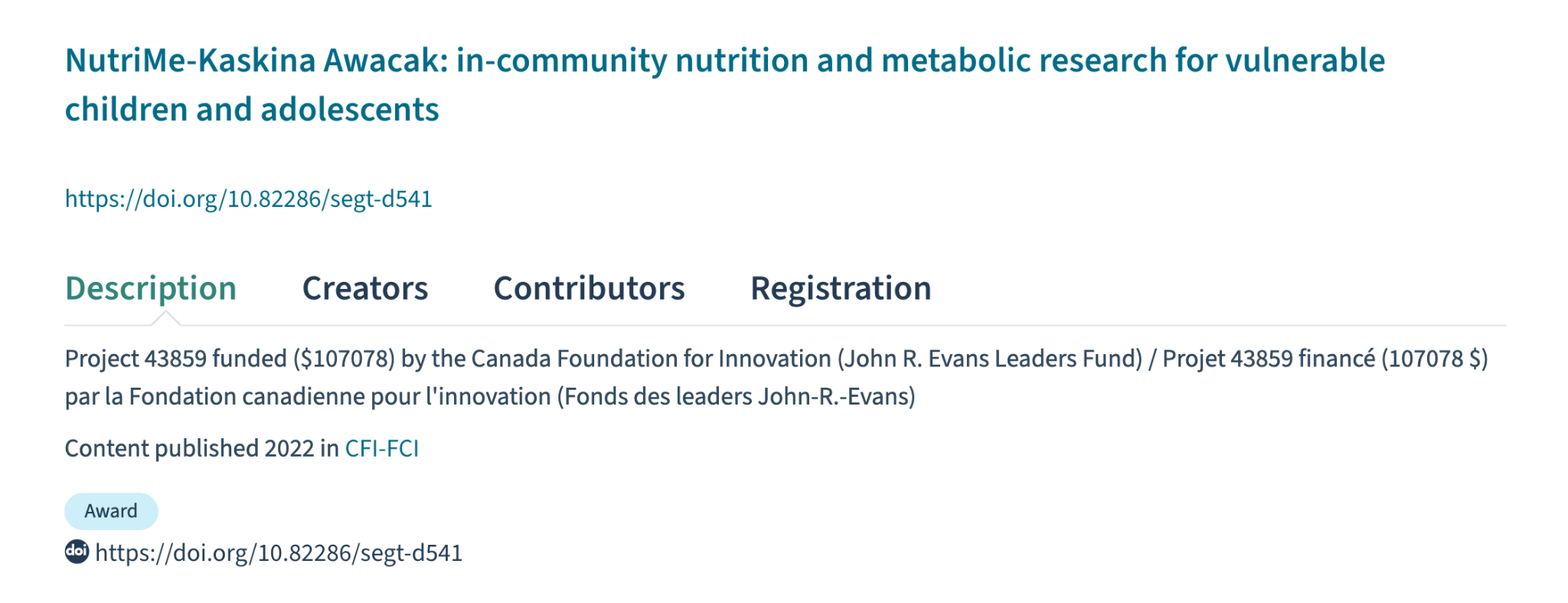
Example of a CFI award page in DataCite Commons displaying award description, creators, contributors, and registration details.
Registering a DOI in DataCite is not an end in itself; it’s an action that connects the award information to global research infrastructure, unlocking key insights, improving research workflows, and driving discovery and impact. Through DataCite metadata and the built-in persistent identifier connections that it supports, the CFI and other funders and research stakeholders within and beyond Canada can easily explore and understand funding activities in context, such as analyzing the researchers and institutions involved in a project, or tracking the outputs that resulted from the funding.
DataCite’s open metadata and connected infrastructure also help researchers and institutions optimize their workflows. For example, researchers can import award information to their ORCID records for easier reporting of activities to funders and institutions. Researchers can reference their Award DOIs in funding acknowledgements for their publications and other outputs, enabling consistent and easier reporting also for their affiliated institutions. Institutions can retrieve funding information from DataCite’s open APIs and discovery tools—as well as the downstream systems and services that harvest DataCite metadata—to track outputs and analyze trends. Funders can check policy compliance and assess portfolio performance by monitoring metadata connections.
A milestone for open and connected funding metadata
The CFI’s project marks a major development in an ongoing movement across the global research landscape focused on elevating the visibility and utility of funding information through persistent identifiers (PIDs), open metadata practices, and connected infrastructure. Open and connected funding information supports greater transparency about research activities and supports funders and other stakeholders in tracking outputs, assessing outcomes, and informing strategic decision-making and future investments. Yet funding information is often isolated in free-text acknowledgments or siloed within internal systems, making it difficult to discover, compare, and reuse across organizations. DOIs for grants and awards help to address this challenge by providing globally unique, machine-actionable identifiers and structured metadata that make funding information more interoperable, discoverable, and reusable.
Funding metadata as part of a broader national strategy to support open research
The CFI has been exploring the use of persistent identifiers to support a more open and trusted research ecosystem in Canada. Through initiatives such as ORCID integration and the adoption of identifiers like the Research Organization Registry (ROR) and Award DOIs, the CFI is working to improve the quality, discoverability, and interoperability of research information.
The CFI’s commitment to leveraging PIDs reflects its vision for a more collaborative and interoperable research landscape. As the organization continues to explore new applications of PIDs, it is helping to strengthen information sharing and coordination among funding agencies and research partners, ultimately benefiting the broader Canadian and international research community.
Canadian funders have become global PID leaders, given their work in this emerging and exciting area of making research (meta)data more interconnected and interoperable. The integration of Award DOIs by the CFI represents a significant milestone and exemplifies an emerging best practice in the Canadian research community. It aligns with the implementation of the Canadian PID Strategy, led by the Canadian Persistent Identifier Advisory Committee (CPIDAC)—which includes the CFI—and is supported by the Digital Research Alliance of Canada and the Canadian Research Knowledge Network (CRKN), which co-manage the DataCite Canada Consortium.
By encouraging convergence around a limited set of widely adopted PID standards, the Canadian PID Strategy seeks to reduce fragmentation across systems and strengthen Canada’s digital research ecosystem. In doing so, comprehensive PID adoption will underpin an effective and equitable research environment in Canada, enabling open and persistent connections between research inputs, activities, outputs, and outcomes.
Future directions for open funding metadata
The CFI’s work with DataCite demonstrates the value of Award DOIs and open and connected funding metadata at scale. DataCite is committed to supporting this vision, advancing open funding metadata with community infrastructure, and convening and participating in community meetings on the topic.
Organizations in Canada wishing to register DOIs for awards can reach out to the DataCite Canada Consortium to get started. Other organizations interested in working with Award DOIs or open funding metadata in general can reach out to the DataCite team to discuss membership options and obtain guidance.

Kris Guntermann - orcid.org/0009-0008-9489-7424 
Senior Business Analyst at Canada Foundation for Innovation | Blog posts

Guy Harding - orcid.org/0009-0002-6047-1931
Director, Information Systems at Canada Foundation for Innovation | Blog posts

Maria Gould - orcid.org/0000-0002-2916-3423
Director of Strategic Programs and Partnerships at DataCite | Blog posts

John Aspler - orcid.org/0000-0001-7055-4357
Manager, Canadian Persistent Identifier Program at Canadian Research Knowledge Network (CRKN) | Blog posts