
Social Media

  • BlueSky
  • Facebook
  • Linkedin
  • Instagram
  • English
  • Français

Login/Register

  • Login
  • Register
Home
  • Licensing
    • CRKN Licensing Principles
    • Model License
    • The Banding System
    • Stakeholder Alignment Group
    • License Negotiations
    • Directories
    • Publishers and Vendors
    • Tools and Services
      • Foreign Exchange Service
      • Perpetual Access Rights Reports (Serials)
  • Open Access
    • Partnership for Open Access
    • Community Open Access Initiatives
    • Read and Publish Agreements
    • APC Discounts
    • Assessment Guidelines for Open Access Publishers
    • CRKN Open Access Journals List
  • Canadiana
    • About the Canadiana Collections
      • Call for Canadiana Collection Development Projects
      • What’s New in the Collections
      • Navigating the Collections
      • System Status
      • Canadiana Citation Guide
      • Canadiana Infrastructure Updates
      • Canadiana Metadata and Usage Reports
      • Rights Statement Project
      • History of Canadiana
    • Digitization Services
      • Digitization Projects
    • Preservation and Access
      • Trustworthy Digital Repository
    • Digital Heritage Content and Preservation Listserv
    • Acquisition and Use of Commercial Microfilm
    • Future of Canadiana
  • Persistent Identifiers
    • ORCID-CA Consortium
      • How to Join ORCID-CA
      • ORCID-CA Governing Committee
    • DataCite Canada Consortium
      • How to Join DataCite Canada
      • DataCite Canada Governing Committee
    • National PID Strategy
    • Canadian Persistent Identifier Advisory Committee
  • Collaborations
    • NISO Membership
    • SCOAP³
    • FMD Membership
    • Coalition for Canadian Digital Heritage
    • HSS Digital Research Infrastructure in Canada
    • More Projects and Collaborations
  • News
    • CRKN Updates
    • Knowledge Exchange
    • Reports
  • Events
    • 2026 CRKN Virtual Conference
    • 2025 CRKN Member Summit and AGM
    • External Events
    • Webinars
    • Code of Conduct
    • Webinar Recordings
  • About
    • Members
    • Board of Directors
    • Committees
      • Executive Committee
      • Finance and Audit Committee
      • Content Strategy Committee
      • Preservation and Access Committee
        • Canadiana Content Sub-Committee
        • Platform Technical Sub-Committee
      • Conference Planning Committee
      • Task Groups
      • CRKN Researcher Council
    • Annual Report
    • Staff
    • Careers
    • History of CRKN
    • Ron MacDonald Service Award
    • Associate Membership
    • Strategic Plan
Menu

Enhancing IIIF Content Structure with Range Editing

Blog

January 21, 2026
Knowledge Exchange blog banner

Guest post by: Paul Mollahan, Services Director, Digirati

This article, covering Digirati and CRKN's collaborative work to develop range editing capabilities for the Digirati IIIF Manifest Editor, was originally published on Medium on December 2, 2025. CRKN uses IIIF standards and the Digirati Manifest Editor, among other tools, to deliver and maintain the Canadiana collections and infrastructure.


The latest version of the Digirati IIIF Manifest Editor was released in late November, following the completion of a new Range Editor workbench. This release also included a few significant usability enhancements, including a revised interface for Annotation creation and editing and a series of improvements to the Exhibition Editor.

What is the Range Editor?

The Range Editor workbench provides users with the ability to visually create a IIIF Range, which are used to represent structure within a digitised object beyond the standard default order of the content in the Manifest. Most commonly these ranges are a Table of Contents, supporting users in finding and accessing the digitised content in a logical, accessible order.
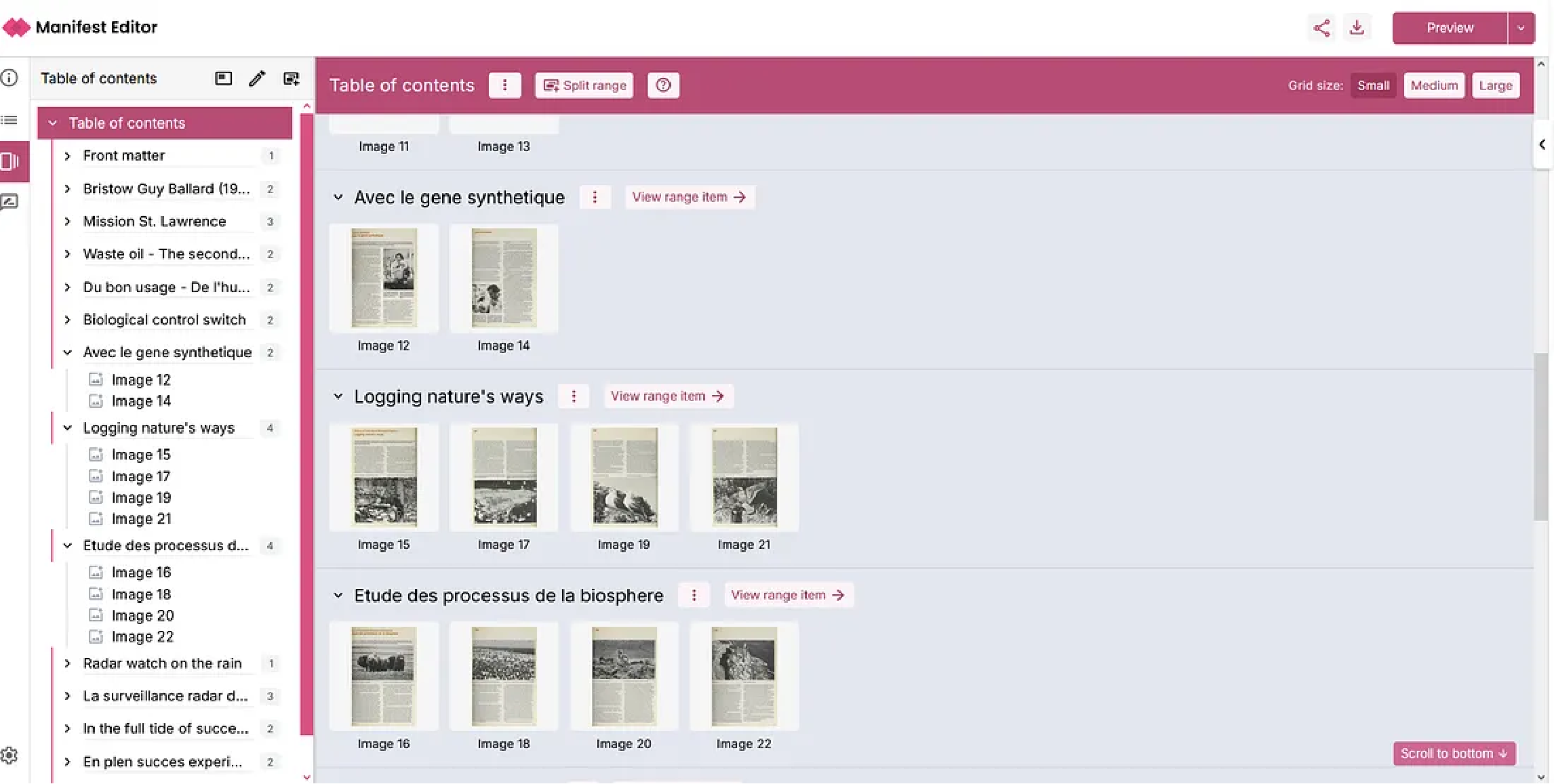
A screenshot showing the creation of a table of contents using the Digirati Manifest Editor.
Fig. 1 Creating a table of contents for a digitised magazine (CRKN)

Developing the concept

The Range Editor workbench development was a collaboration with our partners Canadian Research Knowledge Network (CRKN), with the original ideas for range creation and management initially developed alongside bulk editing features last year.

CRKN evaluated their use cases and earlier this year, we progressed to a design sprint in which the concepts were prototyped in both wireframe and interactive HTML format. The potential overlap and relationship between creating a table of contents to navigate the content and bulk editing activities such as moving the position of one or many canvases (for example the order of a chapter in the digitised pages of a book may have been incorrect) or updating the digitised content as a whole (updating all page or folio numbers for example) was explored to establish how these separate but related workflow processes might interact.

The functional interactive prototype focussed on the usability of editing large manifests, where there are potential for hundreds or thousands of pages that need to be worked on at any one time. Performance of loading in thumbnails representing the canvases (this might be the pages in a book, images of newspaper pages from a newspaper reel) was a key concern, as was the responsiveness of the different actions applied to the content.

The prototypes were collaboratively reviewed with a number of rounds of user testing completed, informing refinements and changes. The main goal of the testing was to better understand how users interacted with key existing features and then performing tasks using the bulk and range editing functionality.

Ten participants took part in the test, including four experienced users and six who were new to both the Manifest Editor and to IIIF. The tests were conducted on the Maze platform, where users’ actions were recorded and analysed.

Patterns emerged from the analysis of the outcomes, with the feedback and observations helping inform design recommendations focused on improving the editor’s usability, making it more intuitive and easier to discover features.

Developing the range editor

Following the completion of the design sprint, the technical architecture and development activity commenced. For the development and testing of the Range Editor feature, we assessed how Ranges are used within existing published IIIF content. The current support for ranges within other IIIF viewing and editorial tools was reviewed to establish a baseline of what the tool should support beyond just interpretation of the IIIF specification.

There were a variety of interpretations that we encountered, not all of which appear to be valid, based on the specification. Initially we considered whether the tool should “correct” these ranges, but after some experimentation we adopted a simple approach. If the existing range is invalid, the tool should allow users to easily remove and create a new range should they wish to update it.

Another challenge we reviewed in detail was how creating and editing a range for a IIIF Manifest should interact with other editorial activities. Structural changes to a Manifest — like adding missing pages or reordering content due to omissions or errors in the digitisation process — can happen at any time.

Therefore rather than trying to have the Range Editor be aware of changes and automatically update accordingly; leaving that task for users to update the range was the most intuitive and pragmatic choice.

The software development activity was split into a couple of phases, enabling user testing and feedback to happen during the implementation. CRKN engaged a group of users to participate in further formal user testing, while we had other Manifest Editor partners involved in the user testing process, with the team at the Technical University of Delft building some exemplar table of contents on digitised books in their collection.

Again these testing outputs helped to further shape and streamline aspects of the features, such as improving the controls available for structuring and rearranging the contents and enhanced wayfinding support for users.
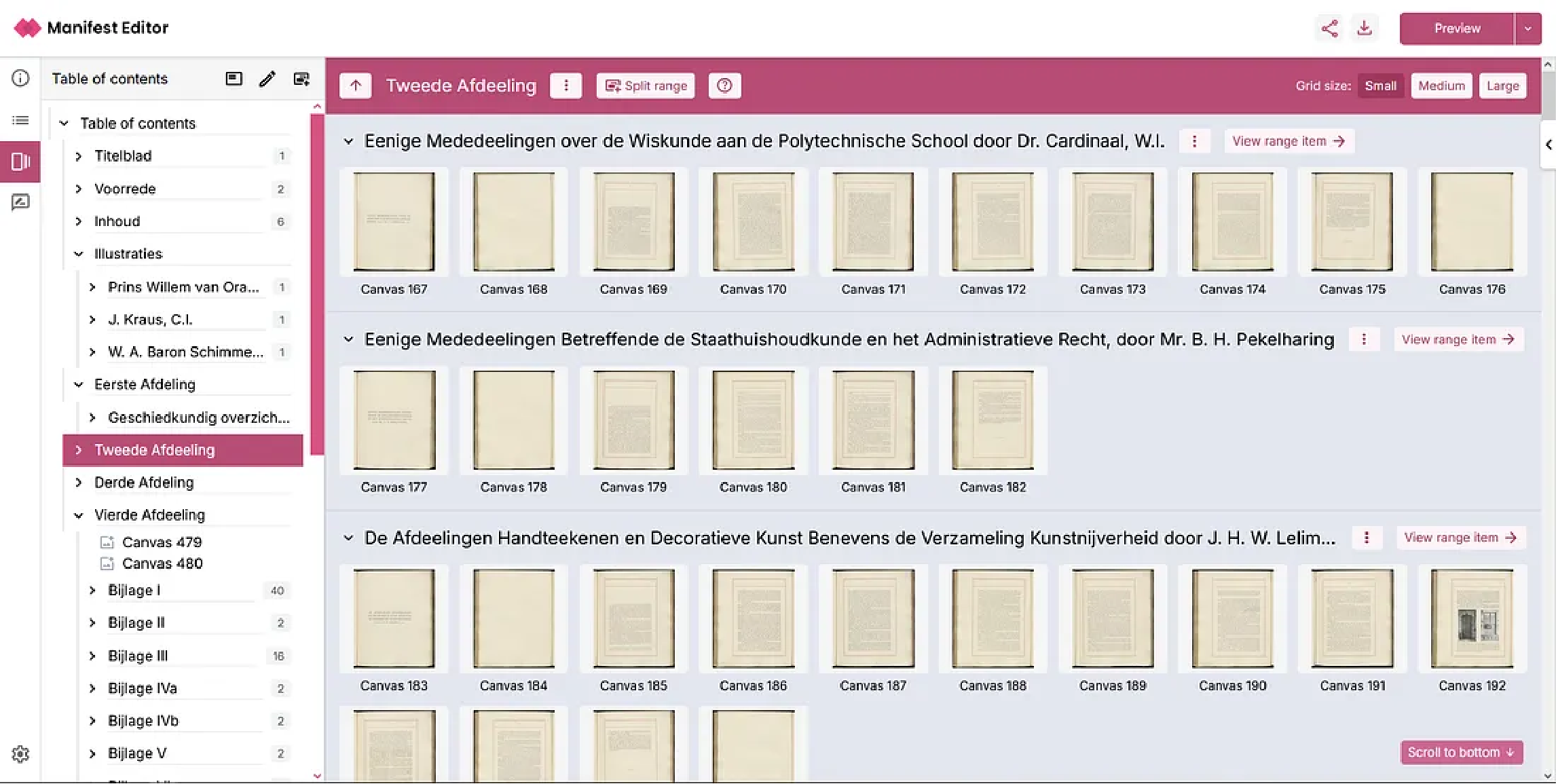
A screenshot of nested sub-ranges created with the Digirati Manifest Editor.
Fig. 2 Working on a nested sub-range item for a digitised book (TU Delft)

Next steps

CRKN are currently exploring new ways to make their collections easier to navigate and more accessible to researchers and the public, with the addition of a table of contents being piloted with an initial collection. (Editor's note: learn more in the Knowledge Exchange post Science Dimension (1969–1984): Seeking Evidence of Women in STEM.)

There were a number of areas that we identified and added to the Manifest Editor backlog for future development; these will be revisited when we receive further user feedback or requests for more features.

The user documentation for the Range Editor is available and will be further enhanced as we receive feedback and assess other examples from the community. We look forward to hearing how our users get on with the tool and how the ranges support users in more easily accessing and finding their way through digitised material.

The latest Manifest Editor is available at https://manifest-editor.digirati.services, and is supported via the IIIF Cloud Services portal for subscribers to that service.


Paul Mollahan headshot


Paul Mollahan

Paul Mollahan is the Services Director at Digirati. He is responsible for governance and direction of a number of open-source products, and a range of projects that the team at Digirati develop and deliver in within the Cultural Heritage domain. 

Related Links

Science Dimension (1969–1984): Seeking Evidence of Women in STEM
During the Fall 2025 term, Olivia Georgiou, Queen’s University undergraduate student in Political Science and History, joined CRKN staff members Percy Miller, Heritage Services Specialist, and Angela Joosse, Community Engagement Specialist, on a...
2025 Wrapped! PIDs Edition
Persistent Identifiers (PIDs) can be a complicated thing to understand, and even harder to explain! Fortunately, CRKN’s dedicated PIDs team was highly active in 2025, both in member support and community outreach. The team participated in more than 20...
2025 Wrapped! Canadiana Edition
What has Canadiana been up to this year? From historians and genealogists to students, community researchers, and lifelong learners, hundreds of thousands of people turned to our digital heritage collections in 2025. To better understand this activity...

Keywords

Blog
crkn footer logo

Canadian Research Knowledge Network

1309 Carling Ave PO Box 35155 Westgate Ottawa, ON K1Z 1A2 t. 613.907.7040

Footer menu

  • Contact Us
  • Newsletter Sign Up
canadiana-footer-logo

CRKN respectfully acknowledges that its offices are located on the traditional, unceded territory of the Algonquin Anishinaabe People. We also recognize that our member institutions are situated across the land now known as Canada, and we extend our respect and gratitude to all First Nations, Métis, and Inuit communities.

Through our work—particularly with the Canadiana and Héritage collections—we are committed to acknowledging colonial injustices, supporting First Nation, Inuit, and Métis data sovereignty, and working in partnership with communities. We strive to engage in respectful practices that honour community protocols and uphold the right of Indigenous Peoples to determine how materials related to their heritage are governed.

Policy Menu

  • Privacy Policy
  • Accessibility Policy
  • Sitemap
© 2013 - 2026 Canadian Research Knowledge Network
  • Licensing
    • CRKN Licensing Principles
    • Model License
    • The Banding System
    • Stakeholder Alignment Group
    • License Negotiations
    • Directories
    • Publishers and Vendors
    • Tools and Services
      • Foreign Exchange Service
      • Perpetual Access Rights Reports (Serials)
  • Open Access
    • Partnership for Open Access
    • Community Open Access Initiatives
    • Read and Publish Agreements
    • APC Discounts
    • Assessment Guidelines for Open Access Publishers
    • CRKN Open Access Journals List
  • Canadiana
    • About the Canadiana Collections
      • Call for Canadiana Collection Development Projects
      • What’s New in the Collections
      • Navigating the Collections
      • System Status
      • Canadiana Citation Guide
      • Canadiana Infrastructure Updates
      • Canadiana Metadata and Usage Reports
      • Rights Statement Project
      • History of Canadiana
    • Digitization Services
      • Digitization Projects
    • Preservation and Access
      • Trustworthy Digital Repository
    • Digital Heritage Content and Preservation Listserv
    • Acquisition and Use of Commercial Microfilm
    • Future of Canadiana
  • Persistent Identifiers
    • ORCID-CA Consortium
      • How to Join ORCID-CA
      • ORCID-CA Governing Committee
    • DataCite Canada Consortium
      • How to Join DataCite Canada
      • DataCite Canada Governing Committee
    • National PID Strategy
    • Canadian Persistent Identifier Advisory Committee
  • Collaborations
    • NISO Membership
    • SCOAP³
    • FMD Membership
    • Coalition for Canadian Digital Heritage
    • HSS Digital Research Infrastructure in Canada
    • More Projects and Collaborations
  • News
    • CRKN Updates
    • Knowledge Exchange
    • Reports
  • Events
    • 2026 CRKN Virtual Conference
    • 2025 CRKN Member Summit and AGM
    • External Events
    • Webinars
    • Code of Conduct
    • Webinar Recordings
  • About
    • Members
    • Board of Directors
    • Committees
      • Executive Committee
      • Finance and Audit Committee
      • Content Strategy Committee
        • Knowledge Base Entitlements Sub-Committee
      • Preservation and Access Committee
        • Canadiana Content Sub-Committee
        • Platform Technical Sub-Committee
      • Conference Planning Committee
      • Task Groups
      • CRKN Researcher Council
    • Annual Report
    • Staff
    • Careers
    • History of CRKN
    • Ron MacDonald Service Award
    • Associate Membership
    • Strategic Plan