Social Media

  • BlueSky
  • Facebook
  • Linkedin
  • Instagram
  • English
  • Français

Login/Register

  • Login
  • Register
Home
  • Licensing
    • CRKN Licensing Principles
    • Model License
    • The Banding System
    • 2026 License Negotiations
      • Stakeholder Alignment Group
    • License Negotiations
    • Directories
    • Publishers and Vendors
    • Tools and Services
      • Foreign Exchange Service
      • Perpetual Access Rights Reports (Serials)
  • Open Access
    • Partnership for Open Access
    • Community Open Access Initiatives
    • Read and Publish Agreements
    • APC Discounts
    • Assessment Guidelines for Open Access Publishers
    • SCOAP³
    • CRKN Open Access Journals List
  • Canadiana
    • About the Canadiana Collections
      • Call for Canadiana Collection Development Projects
      • What’s New in the Collections
      • Navigating the Collections
      • System Status
      • Canadiana Citation Guide
      • Canadiana Infrastructure Updates
      • Canadiana Metadata and Usage Reports
      • Rights Statement Project
      • History of Canadiana
    • Digitization Services
      • Digitization Projects
    • Preservation and Access
      • Trustworthy Digital Repository
    • Digital Heritage Content and Preservation Listserv
    • Acquisition and Use of Commercial Microfilm
    • Future of Canadiana
  • Persistent Identifiers
    • ORCID-CA Consortium
      • How to Join ORCID-CA
      • ORCID-CA Governing Committee
    • DataCite Canada Consortium
      • How to Join DataCite Canada
      • DataCite Canada Governing Committee
    • National PID Strategy
    • Canadian Persistent Identifier Advisory Committee
  • Collaborations
    • Coalition for Canadian Digital Heritage
    • HSS Digital Research Infrastructure in Canada
  • News
    • CRKN Updates
    • Knowledge Exchange
    • Reports
  • Events
    • 2026 CRKN Virtual Conference
    • 2026 CRKN Member Summit and AGM
    • External Events
    • Webinars
    • Code of Conduct
    • Webinar Recordings
  • About
    • Members
      • Associate Membership
    • Board of Directors
    • Committees
      • Executive Committee
      • Finance and Audit Committee
      • Content Strategy Committee
      • Preservation and Access Committee
        • Canadiana Content Sub-Committee
        • Platform Technical Sub-Committee
      • Conference Planning Committee
      • Task Groups
      • CRKN Researcher Council
    • Annual Report
    • Staff
    • Careers
    • History of CRKN
    • Ron MacDonald Service Award
    • Strategic Plan
Menu

Inside the Archives: Digitizing 6 Million Day School Records

Blog

March 25, 2026
Knowledge Exchange blog banner

Guest post by: 

Brianne Boucher, Lead Archivist, Day Schools Project, Library and Archives Canada
Beth Greenhorn, Manager, Day Schools Project, Library and Archives Canada

https://doi.org/10.82389/e79e-y632

Understanding Federal Indian Day Schools Records at Library and Archives Canada

The federal government funded and operated a network of Indian Day Schools across Canada. Located in every province and territory except Newfoundland and Labrador, these schools formed part of a broader colonial education system designed to assimilate First Nations, Inuit, and Métis Nation children into Euro-Canadian society. An estimated 200,000 Indigenous children attended Day Schools, with many schools operating from the late nineteenth century into the 1990s.
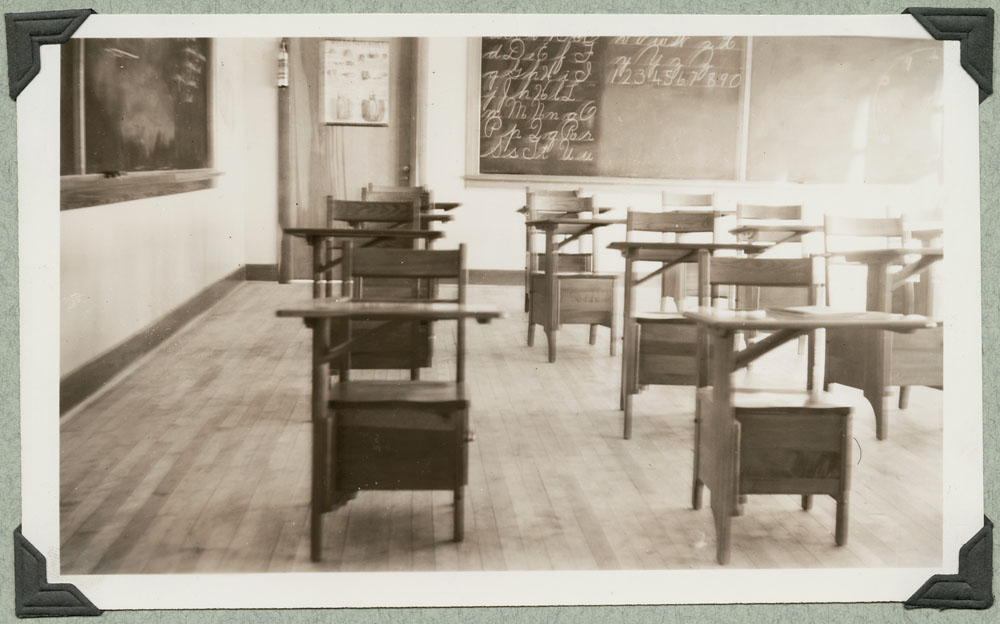
An empty classroom with chairs attached to desktops and blackboards on the walls. One of the blackboards has the alphabet and the numbers 0-9 written on it.
East view of one of four classrooms at Day School, Hay River, Northwest Territories, 1949. Source: Library and Archives Canada/Department of Indian Affairs and Northern Development fonds/e011080294, MIKAN: 4626853

Unlike Indian Residential Schools, children attending Day Schools generally returned home at the end of the school day. However, this distinction did not shield students from harm. Day School students were subjected to similar forms of cultural assimilation, systemic racism, neglect, and, in many cases, physical, emotional, and sexual abuse. The impacts of these experiences continue to affect individuals, families, and communities today. For Survivors, their families, and researchers, archival records related to Day Schools are essential for uncovering these histories and their ongoing legacies.

Library and Archives Canada (LAC) holds thousands of records documenting the administration and operation of the Federal Indian Day Schools system. Created primarily by the former Department of Indian Affairs and Northern Development and its predecessors, these records span more than a century and include textual files, photographs, architectural plans, maps, and other media. Produced for administrative purposes, they reflect a colonial bureaucratic worldview shaped by government categories, terminology, and perspectives that often obscure or depersonalize the lived experiences behind them. Historically, the records have been difficult to navigate, particularly for those seeking information about specific schools, communities, or individuals.
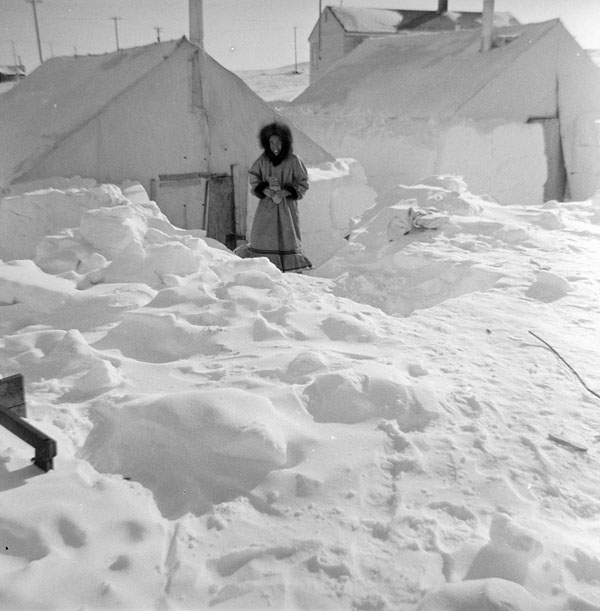
An Inuk woman in a long coat stands in front of tent structures surrounded by snowbanks.
Inuk in front of the Day School Tent Hostel, Kugluktuk (formerly Coppermine) Nunavut, 1959. Source: Library and Archives Canada/National Film Board of Canada fonds/e006609558, MIKAN 3615190

The Day Schools Project: improving discoverability

The Day Schools Project (DSP) ran from 2022 to February 2026. The project’s mandate was to digitize, describe, and significantly improve the discoverability of up to six million pages of archival material related to the Federal Indian Day Schools system and its legacy.

Before the project began, the majority of records relating to Day Schools were searchable at an accession level where there was only a brief description of the file contents. The finding aids had to be consulted if they had not yet been imported into the public database, so not everything was searchable by keyword.  

The DSP team undertook the task of creating enhanced file-level descriptions for tens of thousands of files. These descriptions were designed to help Survivors and researchers better understand the contents of each file before requesting access. They include the types of documents within a file, the Indigenous communities and school locations, the names of schools and related institutions, and whether student or staff names were mentioned. The team also identified and described specialized media, including photographs, maps, and architectural plans. This information is now fully searchable by keyword and media format.

In addition to creating enhanced file-level descriptions, the team imported finding aids that were previously not searchable by keyword. This resulted in an additional 300,000 file-level entries. To further support access, they corrected and updated finding aids in LAC’s database. This involved verifying file information, including titles and dates. These updates provide a clearer and more accurate picture of the files related to Day Schools.
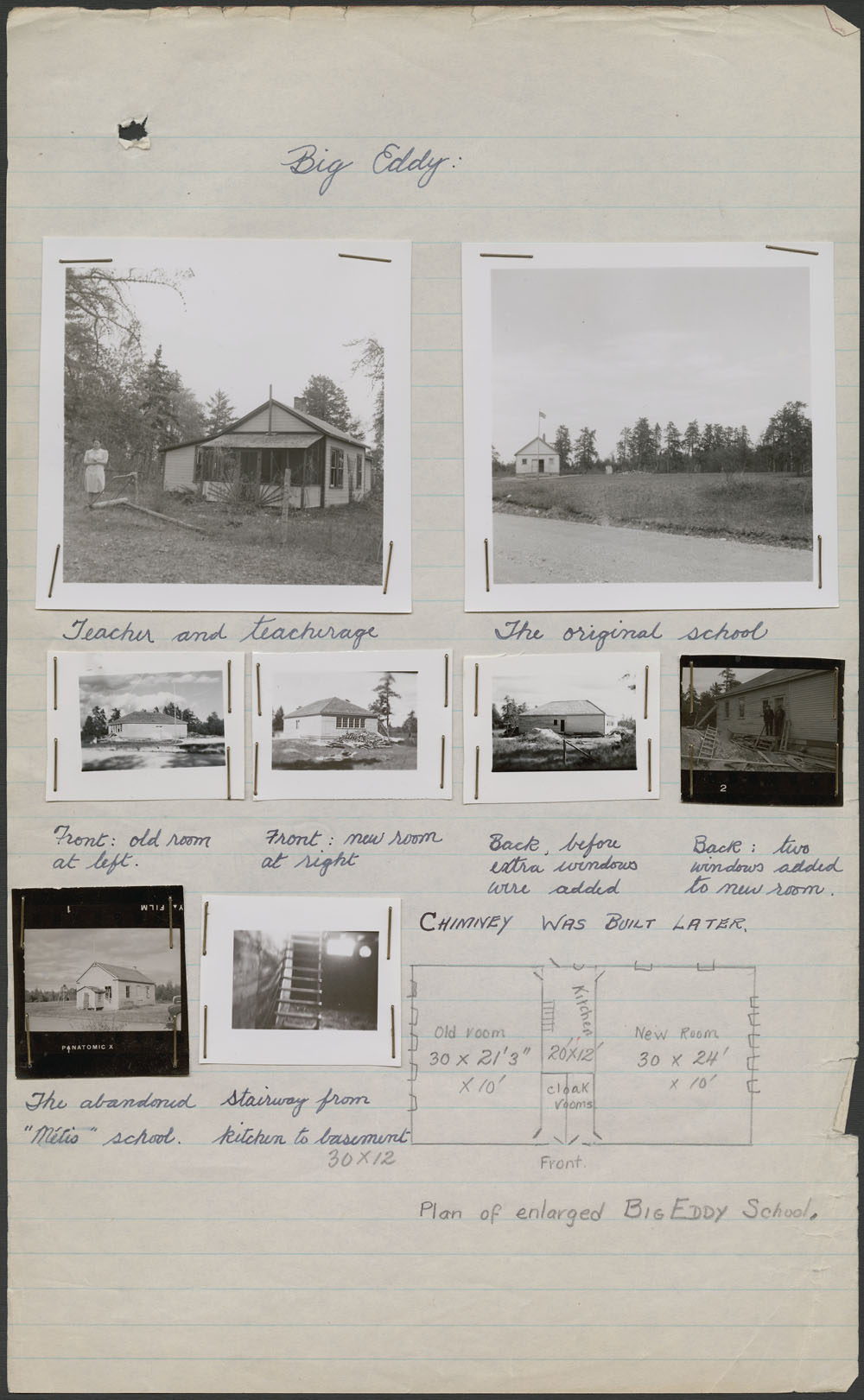
A piece of lined paper with handwritten notes and photos stapled to it.
Big Eddy Indian Day School, photos and notes, The Pas, Manitoba, circa summer 1947.
Source: Library and Archives Canada/Department of Indian Affairs and Northern Development fonds/e011078102, MIKAN 4673878

Navigating restricted records

While some of the Day Schools related records are open to the public (Code 90) and viewable in LAC’s online database, the majority of them are restricted by law under the Access to Information Act and the Privacy Act (Code 32). This is due to the fact that they contain personal information. Access to them can be requested through an Access to Information and Privacy (ATIP) request, submitted via LAC's website.

The enhanced descriptions enable clients to better assess a file’s relevance before initiating an ATIP request, ultimately saving time and narrowing the scope of their requests.

Research tools 

Recognizing that discoverability and access is facilitated by enhanced descriptions, the DSP developed research tools to support clients. These include the DSP Overview and Research Guide available on LAC’s website, which explain the historical context of the records, how they were created, how to search for them, and how to submit an ATIP request.

Additionally, the team wrote Documents of a Colonial System: Day Schools Records at Library and Archives Canada, an eBook that situates the records within the broader history of federal Indigenous education policy. Together, these tools help Survivors, their families, and researchers navigate complex archival records.

Looking ahead

While the DSP formally concluded in February 2026, its impacts extend well beyond the life of the initiative. By enhancing file-level descriptions, improving finding aids, and developing research tools, the project has improved how Day School records are discovered. As a result, the DSP has contributed to more transparent, researcher-centred archival description. 


Editor's note: Learn more about the Day Schools Project at the 2026 CRKN Virtual Conference on May 12–14! View the program and register today.

Brianne Boucher headshot


Brianne Boucher

Brianne Boucher is Lead Archivist on the Day Schools Project at Library and Archives Canada (LAC), where she works to increase the discoverability of records for Survivors of the Federal Indian Day School system. She began her archival career at LAC in 2014, working on the Document Disclosure Project for the Truth and Reconciliation Commission of Canada. Since then, she has worked with LAC’s Research Support team, contributing to the development of Indigenous Reference Services and working directly with clients and Indigenous communities to support their research and enable them to connect with the records.
Beth Greenhorn headshot


Beth Greenhorn (https://orcid.org/0009-0001-5780-6967)

Beth Greenhorn is Manager on the Day Schools Project at Library and Archives Canada (LAC), where she leads initiatives to improve access to records for Survivors of the Federal Indian Day School system. With over twenty-five years of experience in archives, museums, and public history, she has led nationally recognized projects at the intersection of Indigenous histories, archival practice, and community engagement. From 2003 to 2017, she managed Project Naming, an award-winning initiative partnering with Indigenous communities to identify individuals in archival photographs. She co-edited Atiqput: Inuit Oral History and Project Naming (McGill-Queen’s, 2022), winner of the 2023 Clio Prize.

Related Links

From Reels to Reading Online: Digitizing Microfilm at CRKN
At the heart of many digital heritage collections is an unsung hero that deserves some love. The name of that hero? Microfilm! If you’ve ever browsed a historical newspaper on Canadiana or an archival collection on Héritage, you’ve used digitized...
When Writers Fall in Love: Infamous Romantic Era Couples Who Changed Literature
This Valentine’s Day, we’re celebrating love stories that shaped literary history with the help of open access research. We're highlighting two fascinating couples from the Romantic era: Mary Wollstonecraft and William Godwin, and their daughter Mary...
Science Dimension (1969–1984): Seeking Evidence of Women in STEM
During the Fall 2025 term, Olivia Georgiou, Queen’s University undergraduate student in Political Science and History, joined CRKN staff members Percy Miller, Heritage Services Specialist, and Angela Joosse, Community Engagement Specialist, on a...

Keywords

Blog
crkn footer logo

Canadian Research Knowledge Network

1309 Carling Ave PO Box 35155 Westgate Ottawa, ON K1Z 1A2 t. 613.907.7040

Footer menu

  • Contact Us
  • Newsletter Sign Up
canadiana-footer-logo

CRKN respectfully acknowledges that its offices are located on the traditional, unceded territory of the Algonquin Anishinaabe People. We also recognize that our member institutions are situated across the land now known as Canada, and we extend our respect and gratitude to all First Nations, Métis, and Inuit communities.

Through our work—particularly with the Canadiana and Héritage collections—we are committed to acknowledging colonial injustices, supporting First Nation, Inuit, and Métis data sovereignty, and working in partnership with communities. We strive to engage in respectful practices that honour community protocols and uphold the right of Indigenous Peoples to determine how materials related to their heritage are governed.

Policy Menu

  • Privacy Policy
  • Accessibility Policy
  • Sitemap
© 2013 - 2026 Canadian Research Knowledge Network
  • Licensing
    • CRKN Licensing Principles
    • Model License
    • The Banding System
    • 2026 License Negotiations
      • Stakeholder Alignment Group
    • License Negotiations
    • Directories
    • Publishers and Vendors
    • Tools and Services
      • Foreign Exchange Service
      • Perpetual Access Rights Reports (Serials)
  • Open Access
    • Partnership for Open Access
    • Community Open Access Initiatives
    • Read and Publish Agreements
    • APC Discounts
    • Assessment Guidelines for Open Access Publishers
    • SCOAP³
    • CRKN Open Access Journals List
  • Canadiana
    • About the Canadiana Collections
      • Call for Canadiana Collection Development Projects
      • What’s New in the Collections
      • Navigating the Collections
      • System Status
      • Canadiana Citation Guide
      • Canadiana Infrastructure Updates
      • Canadiana Metadata and Usage Reports
      • Rights Statement Project
      • History of Canadiana
    • Digitization Services
      • Digitization Projects
    • Preservation and Access
      • Trustworthy Digital Repository
    • Digital Heritage Content and Preservation Listserv
    • Acquisition and Use of Commercial Microfilm
    • Future of Canadiana
  • Persistent Identifiers
    • ORCID-CA Consortium
      • How to Join ORCID-CA
      • ORCID-CA Governing Committee
    • DataCite Canada Consortium
      • How to Join DataCite Canada
      • DataCite Canada Governing Committee
    • National PID Strategy
    • Canadian Persistent Identifier Advisory Committee
  • Collaborations
    • Coalition for Canadian Digital Heritage
    • HSS Digital Research Infrastructure in Canada
  • News
    • CRKN Updates
    • Knowledge Exchange
    • Reports
  • Events
    • 2026 CRKN Virtual Conference
    • 2026 CRKN Member Summit and AGM
    • External Events
    • Webinars
    • Code of Conduct
    • Webinar Recordings
  • About
    • Members
      • Associate Membership
    • Board of Directors
    • Committees
      • Executive Committee
      • Finance and Audit Committee
      • Content Strategy Committee
        • Knowledge Base Entitlements Sub-Committee
      • Preservation and Access Committee
        • Canadiana Content Sub-Committee
        • Platform Technical Sub-Committee
      • Conference Planning Committee
      • Task Groups
      • CRKN Researcher Council
    • Annual Report
    • Staff
    • Careers
    • History of CRKN
    • Ron MacDonald Service Award
    • Strategic Plan